
It’s not just for pigs anymore. What was once known simply as liquid waste, mud or unappetizing food now inhabits our phones. In fact, it’s on all of our electronic devices. And it may be even worse than spam, junk or, for heaven’s sake, the dreaded clickbait. This insidious yucky stuff known as “slop” is infiltrating our lives online in record time. Not surprisingly, it is Merriam-Webster’s Word of the Year for 2025. Allow me to look it up for those of you who choose to lead a more meaningful, analog life. Slop is the onslaught of low-quality, artificial intelligence-generated content that fills our social media feeds and seeps into every corner of the internet. You know, those absurd videos, wacky ads, cheesy propaganda and fake news that looks just real enough to pique your interest? That’s slop. Oh, and the well-dressed cats who say stuff like, “What the hell?” Lots of cats. I’m not really a cat person, but even I found that one amusing.
In other words, crappy AI content is all about quantity over quality. So much so, that it’s powerful enough to “ooze into everything,” says Merriam-Webster. Plus, slop is much harder to spot and has evidently scrambled our scrolling.
No wonder I’m anxious. Yet another thing to fray my last nerve, along with the price of coffee and gratuitous renaming of historical buildings.
Even the staid Wall Street Journal warns that “AI slop is everywhere,” as in ubiquitous, which I will happily look up for you: Something that is “everywhere,” but not in a lovely way like the 1966 Beatles song “Here, There and Everywhere.”
Everywhere as in cell phones or free public WiFi. Or like “coffee shops” (puff puff) in Amsterdam that sell far more joints than cappuccinos. You’ve got to love Dutch laws, but not as much as their stroopwafels.
Thankfully, human editors at Merriam-Webster – the oldest dictionary publisher in the United States – assure us that calling low-quality AI-generated content “slop” sets a tone that is more mocking than fearful.
According to their news release, “The word sends a little message to AI: When it comes to replacing human creativity, sometimes you don’t seem too superintelligent,” which may or may not be two words. I say yes.
“Like slime, sludge and muck, slop has the wet sound of something you don’t want to touch,” the release continues. “Slop oozes into everything.”
Even this blog post that you’re reading. Truly.
I created both images for this blog using Google Gemini’s AI Intelligent Assistant tool. I didn’t know how it worked, so it was a challenge, but I figured it out. The result felt like … magic. Here’s how:
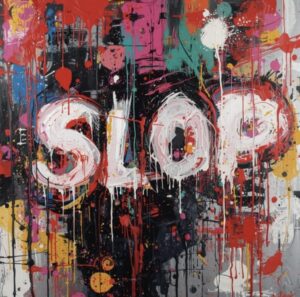
- I went to Google Gemini’s website and typed a few words into the search field – “slop, Word of the Year, colorful” – then submitted it to create an image, and look what appeared? This suitable, noncopyrighted free image on your left. Not great, but not horrible either. Did I mention it’s free?
- Here’s another more complicated example I tried for sh*ts and giggles. Again, using Google Gemini, I typed in a detailed description of what I wanted the image to contain: “A dark brown Wheaton Poodle puppy wearing a shamrock bandana and a dog tag that says ‘Laddie’ who is sightseeing in Ireland with his favorite stuffed moose toy.”
Now scroll up and look at the main image on this post. Incredible, right? Again, this was created by Google Gemini.
Full disclosure: The pooch pic is actually based on our Irish friend Kelly’s 6-month-old dog, Laddie, although I’m not sure why that lone hiker wearing an orange backpack is traveling with him in Ireland.
Oh, wait, it’s fake!
Free or not, low-quality AI-generated content is going to put graphic designers out of business, as well as artists and writers. Frankly, it may well displace most of our talented “creatives,” as they’re now called.
Like comedian Kumail Nanjiani’s “night thoughts,” this keeps me up, as well as “What does CVS stand for?” (Consumer Value Store, if you’re wondering.)
Beware of slop as you doomscroll the socials on your phone, my friends.
I’m no doctor, but I suspect that obsessive consumption of devouring too much slop may lead to the Oxford University Press 2025 Word of the Year: “rage bait.” That’s online content deliberately designed to elicit anger or outrage by being frustrating, provocative or offensive.
And why is rage bait two words and clickbait one? I find that outrageous.
(YouTube music: From their 1966 album Revolver, here is the Beatles love ballad, “Here, There and Everywhere.” Paul McCartney includes it among his personal favorites of songs he has written with John Lennon. Citing the Beach Boys’ “God Only Knows” as a source of inspiration, Paul began writing this song at Lennon’s home in Weybridge, apparently waiting for John to wake up.)




6 Comments
Lenore Leah Devlin
Thanks for this blog. I HATE the slop that’s everywhere. It’s disgusting. Looking forward to seeing you soon. Happy New Year!
Jennifer John
Me, too. Thanks, L!
Emily Everett
I’m old enough to be wary of AI, no matter how good it looks. It kinda scares me.
Jennifer John
Exactly. Thanks, Em.
Laurie Marlow
AI is artificial, and therefore not very intelligent, but I fear you are right about it putting many people out of jobs. I’m glad I’m not a young person with a lot of years left to suffer through this horrible world that is being created to destroy us.
Jennifer John
Plus we know Laddie’s a lot more handsome than that fake dog, right? Thanks, L.