
It’s not often I relish the age that I am, as in happy to be in my so-called golden years. But this weekend made me realize I’m glad that I’m old. The co-founder and CEO of the artificial intelligence company, Anthropic, put the brakes on frontier AI safety and research. And he called on other businesses in the field to do the same. Too much, too soon? You bet your chat bots, Claude. It took the head of Anthropic to write a 3,800-word essay, but his point was clear: Slow your roll. Engineers can’t keep up with advanced AI models. And the billionaire owner of this private company believes it is possible that these advanced AI models can become evil and will cause a truly global catastrophic event. Anthropic has pledged to have third-party evaluation of its models, which may slow new releases and cost them money. Think about that last sentence. A private company is asking for oversight and regulation.That’s crazy talk. One Anthropic researcher has resigned because he said the company was “gambling with our lives,” adding that “The people building AI earnestly believe that it could kill us all by the end of the decade.” Apocalypse … now?
No wonder I’m still in AFib.
It might not kill me, but some advanced, out-of-control and wildly indifferent AI model will off me in my sleep because I am an aging, unproductive human with an irregular heartbeat.
This is why my eldest sister watches “Little House on the Prairie” where the wholesome Ingalls’ family’s only real peril is hungry wolves in the Kansas plains.
In other news, September is National AFib Awareness Month. I’m not making this up. My friend Tina B. told me. She knows about all things AFib.
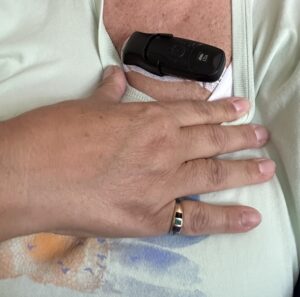
So, for the next 14 days – to promote early detection (read: mine) and honor this dedicated effort to educate the public about irregular heartbeats and cardiac arrhythmia – I’ve got a 4-inch black flash drive stuck to my chest: the BodyGuardian MINI heart monitor.
This wearable waterproof gadget tracks heart rhythms, respiration and activity levels as you go about your daily routine. If you feel any AFib symptoms – such as light-headedness, fatigue, nausea or flop sweats – you push the monitor’s button and write down the details. Date, symptom, etc.
I see my cardiologist in October to review the results. Stay tuned.
Back story: My initial cardioversion earlier this month was canceled due to a major WiFi outage at Corewell Health Royal Oak Hospital. Cardioversion is a quick, low-energy shock delivered through chest pads while you are sedated to instantly snap the heart back into rhythm. My last one in 2022 held for four years.
Then last week when I was rescheduled for the same procedure, my fickle heart decided not to be in atrial fibrillation. No arrhythmia for you, Jennifer.
What docs thought was an ECG flutter wasn’t, so after prepping me for the procedure with an IV poke, oxygen and a multitude of colorful wires and sticky electrodes, they sent me home. I was bummed.
Kind of like bringing your car in to fix a noise you’ve been hearing for months, but on that particular day, the darn thing purrs.
Apparently, it’s not a good idea to get zapped when you’re in normal sinus rhythm. Which I was in even though I felt no different than when I wasn’t.
Therein lies the rub.
This AFib business is like a bad penny that keeps turning up. It can be permanent, continuous or come and go on its own. That’s called “paroxysmal” atrial fibrillation, which I may or may not have. Inconclusive. For the moment.
I swear, I’ve become my mother. We’ll save that for another blog.
I must say, my nurse Dominick M. was a hoot (“No charge today”), my substitute cardiologist Dr. Daniel Tim was kind, and my day wasn’t a total loss after meeting Dr. Kassia Biddle, the adorable anesthesiologist who seemed fascinated with my 2001 open-heart surgery to remove a benign intracardiac hemangioma.
“Wow,” she said. “You don’t see those every day.”
No, you do not.
Who knows? Maybe someday those smarty-pants AI safety and research folks will have AFib all figured out. For now, I prefer to take a beat and see what the monitor has to say.
(YouTube video: “Golden Years” is a song by English singer-songwriter and actor David Robert Jones, known as David Bowie, released in 1975. Originally written by Bowie for Elvis Presley, who turned it down, the song was from his 10th studio album, “Station to Station.” Often referred to as the “chameleon of rock,” Bowie is regarded as among the most influential musicians of the 20th century. In 2016, he died of liver cancer in his New York City apartment. He was 69.)