Seems as if each time I sit down to write lately, my mind goes to a dark place. I feel sad, disconnected, unmoored. Like a boat adrift at sea. There’s a chill in the air, and not just because it’s late January and the coldest air mass since 1948 has blanketed the state of Florida. You may have heard the phrase, “The Revolution will not be televised.” I suspect the author of that line from his famous poem of the same name, American jazz poet Gil Scott-Heron, had no idea when he wrote it in 1971 that 55 years later the revolution would be “live” and in color on tens of millions of devices called mobile phones. No texting required. Just hit record, and watch it happen before your very eyes.
For the second time in three weeks, a 37-year-old American has been executed on the streets of Minneapolis by U.S. Immigration and Customs Enforcement, America’s secret police.
Please read that sentence one more time.
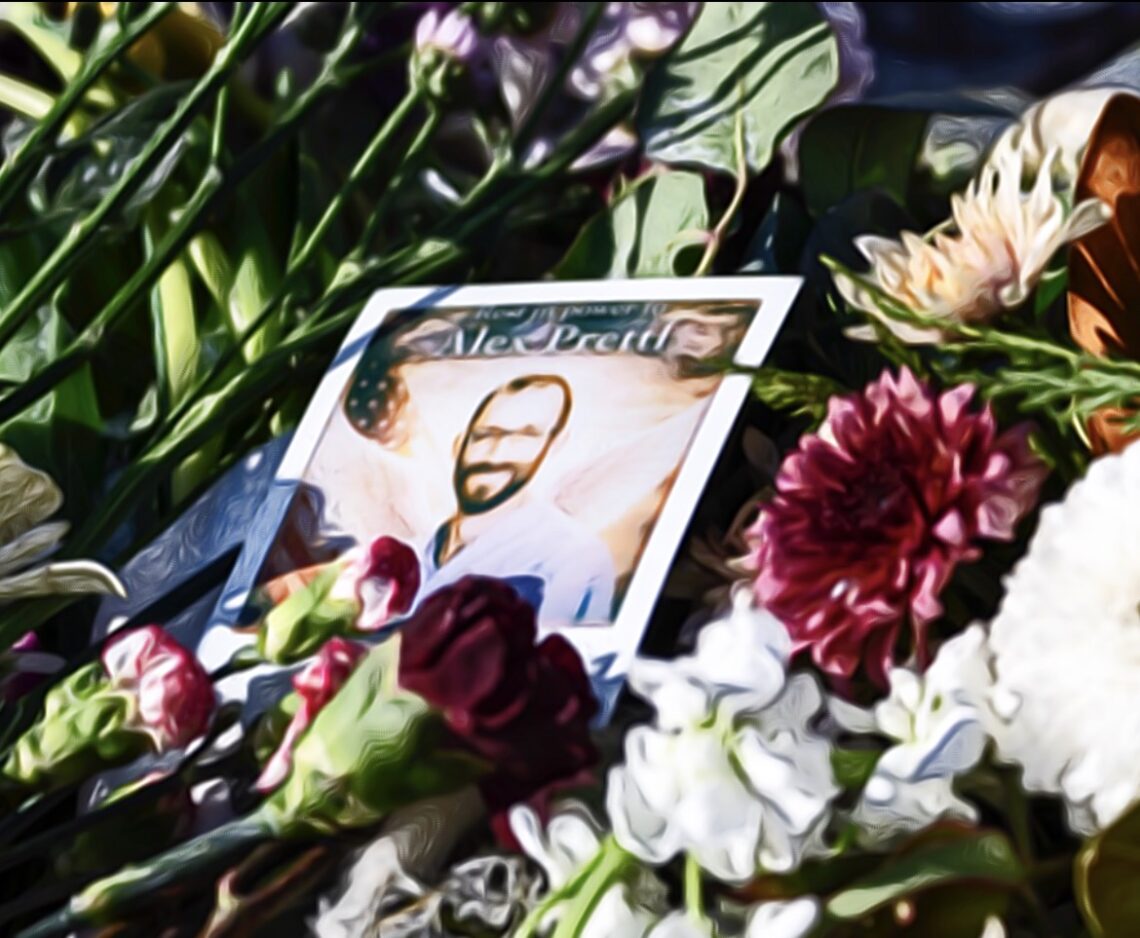
In this case, Alex Jeffrey Pretti, an intensive care nurse for the U.S. Department of Veterans Affairs, was pepper-sprayed in the face by ICE agents and pushed to the ground at a peaceful protest on January 24. Then, he was shot 10 times at close range by not one but two ICE agents.
Pretti had a cell phone in one hand and nothing in the other. It’s all on video, of course, because it’s 2026 and people take photos and videos of everything, and not just their meals. This time, the ubiquitous devices were documenting a crime in real time.
Just as federal agents did when they murdered wife and mother of three Renee Nicole Good in her car on January 7. On a street in Minneapolis, all captured on video.
Yes, Pretti had a gun and a concealed weapons permit, which is legal in open-carry state Minnesota. You can bring a firearm into a Dunkin’ Donuts to protect you ordering a French cruller. Guns are also welcomed into their state Capitol building. The right to bears arms and all that.
In the Land of 10,000 Lakes, you might say that carrying a gun is as common as carrying a cell phone. But not if you’re peacefully protesting, apparently. Second Amendment be damned.

According to his parents, who called Alex “a kind-hearted soul,” their son wanted to make a difference in the world. His final act on this earth was to help a woman who had been pushed to the ground by ICE agents.
Here’s a statement from his sister, Micayla Pretti: “Through his work at the VA caring for the sickest patients, and passion to advance cancer research, he touched more lives than he probably ever realized. All Alex ever wanted was to help someone – anyone. Even in his very last moments on this earth, he was simply trying to do just that.”
What was her brother’s crime? Being a Good Samaritan?
Under our Bill of Rights, the first 10 Amendments to the U.S. Constitution, filming law enforcement is a protected activity. It’s a First Amendment right, along with the right to assemble, as in a peaceful protest. (Unlike, say, the riots of January 6, 2021.)
Carrying a gun in Minnesota is legal. (See Second Amendment.)
There was a time in our nation when disasters of such magnitude – murder, mayhem, wars – occurred infrequently, not daily.
Take 1986, for example. Forty years ago today, to be exact.
On January 28, 1986, a much less gray-haired and fitter me was living and working in Miami for Viewdata Corporation of America. It was my first real journalism job, even though it was nontraditional and for a news service called “Viewtron.” Former old media giant Knight-Ridder Corporation owned it, along with the Miami Herald and many other newspapers.
On that particular Tuesday, I had no idea that in fewer than three months I’d be out of a job because Viewtron would fold. After three years, the return on their $50 million investment was still in the red.
“We’re about 10 years too early,” one management suit told me at the time. He wished me well, and I wished he was dead. It was St. Patrick’s Day.
Feeling unlucky and thirsty, a bunch of us went out for beers at The Irish House on Miami Beach. I figured I’d be OK for a while and spend more time at the beach.
On that same January day in 1986, it was my dear friend Cheryl’s birthday. So, I called her up (on my break, of course) to wish her well. It was 11:30 a.m. Not certain why I remember that, but I do.
She was 42. I was 25, a baby – and a long, long way from home. I have turned to her more than once for advice in my 65 years.
About 10 minutes into our conversation, I looked up at the newsroom TV showing the historic launch of the Space Shuttle Challenger, the one with schoolteacher Christa McAulliffe and six others aboard.
The Challenger broke apart 73 seconds into its flight, killing all seven crew members aboard. The spacecraft disintegrated 46,000 feet above the Atlantic Ocean, off the coast of Cape Canaveral. It was 11:39 a.m. EST.
“It blew up,” I said to my old friend on the phone. “Oh, my God. The Challenger blew up.”
We were both incredulous.
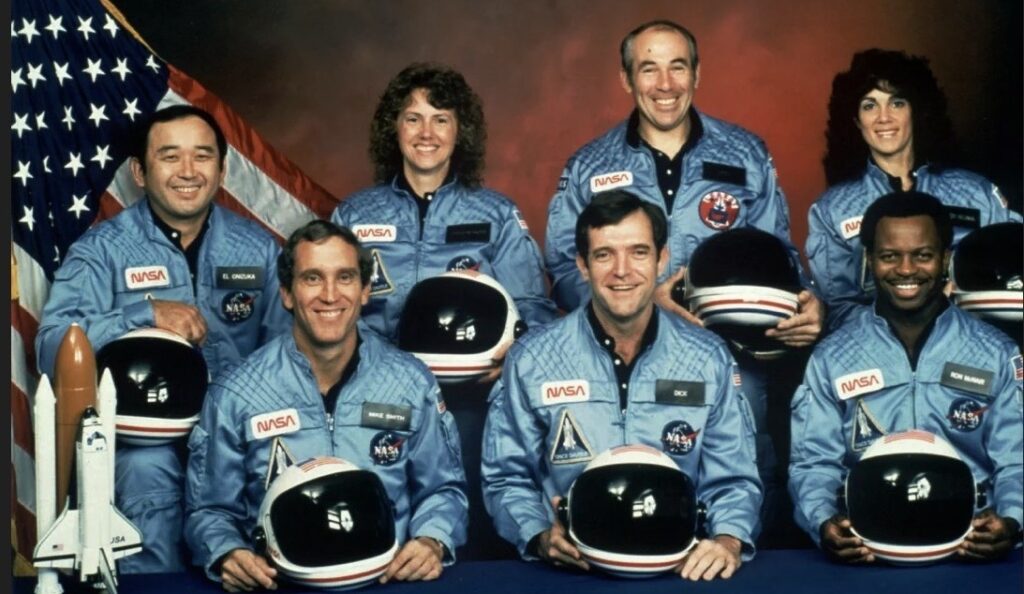
Back row from left: Ellison Onizuka, Christa McAuliffe, Gregory Jarvis and Judith Resnik.
It was the first fatal accident involving an American spacecraft while in flight. The disaster resulted in a 32-month hiatus in the Space Shuttle program.
According to news reports, the Challenger commission concluded it was “an accident rooted in history,” given the evidence of O-ring damage before the fatal launch and the failure to heed the warnings of Morton Thiokol engineers.
“An accident rooted in history.”
Is that what we will call the killings of Alex Pretti and Renee Good 40 years from now? “An accident rooted in history”? I pray not.
Watching “The Last Word with Lawrence O’Donnell” on MS Now the other night, I heard the host say something that has stuck in my head:
“Protests for social justice always win.
And it always takes longer than it should.
And people always die.”
Remember the Challenger crew today.
Remember Alex Pretti and Renee Good today and every day until there’s justice for their murders.
And if you’re so inclined, send my friend some birthday wishes. She doesn’t text or keep her cell phone on, but feel free to call her at home.
(YouTube video: A classic song written by Elton John and lyricist Bernie Taupin, “Rocket Man” was originally released in 1972. In his own interpretation of this iconic hit, Iranian filmmaker and refugee Majid Adin reimagines the song to tell a new story of adventure, loneliness and hope. “And I think it’s gonna be a long, long time …”)





16 Comments
Lenore Leah Devlin
I find that watching the news and the bold-faced lies told by this administration are mind numbing and wondering who believes them?
Jennifer John
Let me know when you find out the answer. Thanks, L.
Mo Baudhuin
Sending you love, Jinny. Feeling unmoored, like you.
Jennifer John
Thanks, Mo.
Michele
Thanks, Jen. Poignant read. I saw that episode with Lawerence and found those words you quoted something to deeply reflect upon. These martyrs for truth should help us stay moored when times get dark. I’m sure praying so.
Jennifer John
So true. Thanks, M.
Tina
Thanks again, Jen, for the well-written, eye-opening article.
Jennifer John
Thanks, T.
John T Davis
Always important, straight to the point. I don’t recognize America, or specifically I don’t recognize Americans who support open Fascism. Hate is a powerful motivator, but to quote a great American, “I have decided to stick to love … hate is too great a burden to bear.” Miss you, my friend.
Jennifer John
MLK’s words are so true. Let’s add some music to that love. Can’t lose. Thanks, JD.
Elissa Driker
Wonderful words, as always.
Jennifer John
Thanks, E.
Laurie Marlow
Feeling your sadness. Once again, a very moving read. Thanks, Jen.
Jennifer John
Thanks, L.
Martha
Beautifully written, my friend. We are all feeling very untethered. All the more reason to grab each others’ hands.
Jennifer John
Good advice, Bamz.